The Paintings of James McNeill Whistler
M.1569
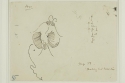
r.: Butterfly; v.: Fragment of butterfly
Date
r.: Butterfly; v.: Fragment of butterfly were drawn in 1899 for the book, James McNeill Whistler, Eden versus Whistler: The Baronet and the Butterfly. A Valentine with a Verdict, Paris: Louis-Henry May, 1899.
r.: Butterfly, Art Institute of Chicago
The sheet is catalogued in MacDonald 1995 (cat. rais.) [more] (cat. no. 1569).
Images
r.: Butterfly; v.: Fragment of butterfly, Art Institute of Chicago
Verso not reproduced.
Subject
Description
r.: Butterfly; v.: Fragment of butterfly, Art Institute of Chicago
A butterfly with drooping shaded cloak or wings, lowered upper limbs or wings (as if bowing), and a long wriggly barbed tail at lower left.
Comments
In 1894 William Eden (1849-1915) commissioned a portrait of his wife Sybil Frances Grey, Lady Eden (1867-1945). Whistler, dissatisfied with the amount (100gns) and manner of payment, retained and altered the portrait (Brown and Gold: Portrait of Lady Eden y408). After an appeal, in December 1897, the Court de Cassation let him retain the portrait but return the money. Whistler was well satisfied to see the Code Napoléon altered, to specify an artist's right to decide the fate of his works.
Whistler planned to publish an account of the affair, a compilation of letters, newspaper reports and legal documents, with William Heinemann (1863-1920), who had published the Gentle Art of Making Enemies in 1890. There was some problem with publishing in London, and, with Heinemann’s tacit agreement, Louis-Henry May in Paris took over the publication. A first proof was run off, using mainly butterflies originally drawn for the Gentle Art of Making Enemies. These butterflies were mostly replaced by new ones, in a second proof. There are at least two versions of some of the designs. They were slightly reduced in size in the final publication.
For the book, Whistler designed 15 butterflies, a club (A club on a cushion m1564), and a frog (Frog m1553). He also drew some butterflies which were not used (v.: Butterfly; r.: see No. 1268 m1572, Butterfly with chequered wings m1578, r.: Butterfly; v.: Butterfly with chequered wings m1579). The Baronet and the Butterfly was comparatively sparing of butterflies. Many marginal annotations, which in the Gentle Art of Making Enemies would have warranted a butterfly, did not get one. Some of the butterflies were very badly reproduced (r. and v.: Butterfly m1561, r.: Butterfly 'Encountered'; v.: Butterfly m1562). There were obviously publication problems, and it was not an entirely satisfactory venture. However, Whistler did not admit of criticism and seems, publicly, to have been entirely satisfied with the outcome.
Technique
Composition
r.: Butterfly; v.: Fragment of butterfly, Art Institute of Chicago
This was drawn for publication in the book by James McNeill Whistler, Eden versus Whistler: The Baronet and the Butterfly. A Valentine with a Verdict, Paris: Louis-Henry May, 1899. The butterfly was not in fact used in the book, Butterfly m1548 being substituted.
Technique
There is a faint pencil butterfly to right, and a line scraped or rubbed out to left of the tail.
The sketch on the verso is rough, and has been changed; it is probably incomplete, and possibly not by Whistler. The butterfly's tail was finished in pencil, and so was a feeler, with a very tentative line. This drawing is the opposite way up from that on the recto.
Conservation History
The thin card has pinholes in the corners on the left, one a bit in from the top right, and two at bottom right; and has rough edges on three sides, but not on the right.
History
Provenance
- 1920: sold on 16 April by Albert Louis Roullier (1858-1920), art dealer, Chicago, to Walter Stanton Brewster (1872-1954);
- 1933: given to the Art Institute of Chicago.
The earlier provenance is unknown. See MacDonald 1995 (cat. rais.) [more] (cat. no. 1561).
Exhibitions
It was not exhibited in Whistler's lifetime.
Bibliography
Catalogues Raisonnés
- MacDonald, Margaret F., James McNeill Whistler. Drawings, Pastels and Watercolours. A Catalogue Raisonné, New Haven and London, 1995 (cat. no. 1569) as 'r.: Butterfly; v.: Fragment of butterfly'.
Authored by Whistler
- Whistler, James McNeill, Eden versus Whistler: The Baronet and the Butterfly. A Valentine with a Verdict, Paris: Louis-Henry May, 1899, p. 58.
Websites
- Clarke, Jay A., and Sarah Kelly Oehler, eds., Whistler Paintings and Drawings at the Art Institute of Chicago, The Art Institute of Chicago, 2020, website (cat. no. 45).
- 'Cats. 40–47 Butterflies and Club: Tombstone,' in Whistler Paintings and Drawings at the Art Institute of Chicago (The Art Institute of Chicago, 2020) URL (cat. no. 45).